
The Race Between Exposure and Exploitation
About Core6™
StorageGuard - by Core6 - is the ONLY Security Posture Management solution for Storage & Backup systems, helping to ensure these systems are secure and compliant.
Why storage and backup infrastructure has become the front line – and why the clock now runs faster than it used to.
There’s a quiet assumption that has held in most security programs for years: if you find a weakness before an attacker does, you’re fine. Patch it on your next cycle, close the ticket, move on.
That assumption was never perfectly true, but it was good enough! The gap between the moment a weakness became known and the moment someone could reliably exploit it was measured in weeks or months – enough breathing room to schedule the fix around change windows, approvals, and everything else competing for your team’s attention.
That breathing room is disappearing. And nowhere is it disappearing faster than in the part of your environment you may have spent the least time thinking about as an attack surface: storage and backup.
Why attackers went after storage and backup in the first place
For most of the last two decades, storage systems sat comfortably in the background. It was plumbing. It held the data, it rarely broke, and security teams focused their energy on endpoints, identities, and the network perimeter. Backup systems were even further down the list – the safety net you hoped you’d never need, quietly running its jobs at 2 a.m.
Attackers noticed the neglect before defenders did.
The logic is uncomfortable but simple. If your goal is to extort an organization, the most valuable thing you can take from them is not access to a single server – it’s the certainty that they can recover without paying you.
So the modern ransomware playbook doesn’t start with encrypting production data. It starts with finding and neutralizing the recovery capability. Delete the snapshots. Corrupt or encrypt the backup repositories. Change the retention settings so that clean copies age out. Disable immutability where it was misconfigured or never turned on. By the time the production environment is hit, the escape hatch has already been welded shut.
This changes the economics entirely. An organization with pristine, isolated, verified backups can treat ransomware as a bad weekend. An organization whose backups were quietly compromised three weeks earlier is looking at a business-defining crisis. Attackers know which of those two situations pays, and they invest accordingly.
And storage platforms give them a lot to work with.
Enterprise environments are rarely uniform – they’re a mix of vendors and generations of hardware accumulated over years: primary arrays, secondary storage, purpose-built backup appliances, and the software layers stitching them together.
Each has its own management interfaces, its own default configurations, its own security advisories, and its own quiet ways of drifting out of a hardened state as people make routine operational changes. Every one of those interfaces is a door. Many of them were installed with the locks still set to the factory default.
The result is a target that is simultaneously high-value and under-defended. That’s not a combination attackers leave alone for long.
How AI compressed the timeline
Here’s where the picture shifts from concerning to urgent.
For years, the thing that protected under-hardened storage and backup infrastructure was effort. Finding an exploitable weakness in a specific storage platform took genuine expertise – someone who understood that storage system’s architecture, could read the security advisory, work out which configurations were actually exposed, and turn that knowledge into a working exploit.
That expertise was scarce and expensive, which meant it was rationed. Attackers spent it on the highest-value targets and left the rest alone simply because it wasn’t worth the hours.
AI is dismantling that natural rate limit.
The tasks that used to gate an attack – reading through documentation and advisories, understanding an unfamiliar platform, spotting the difference between a vulnerable and a hardened configuration, drafting the code to take advantage of it – are exactly the tasks that language models are now good at.
What once required a specialist can increasingly be assembled by someone with far less depth, working far faster. The window between “this weakness is publicly known” and “this weakness is being exploited at scale” has collapsed from months toward days, and in many cases toward hours.
There’s a second effect that matters just as much.
When the cost of developing an attack falls, attackers stop being selective. The old economics protected mid-tier targets and less glamorous parts of the infrastructure because they weren’t worth the effort. Remove the effort, and everything becomes worth attacking. The overlooked backup appliance in a regional data center is no longer beneath notice – it’s just another door, and the cost of trying it has dropped to almost nothing.
Put those two shifts together and you get the race this post is named for.
On one side, the speed at which security weaknesses can be discovered and weaponized. On the other, the speed at which your organization can find and fix them. For most enterprises, the first side just got dramatically faster while the second stayed exactly where it was – reliant on periodic assessments, manual reviews, and remediation queued behind everything else.
The metric that actually matters now
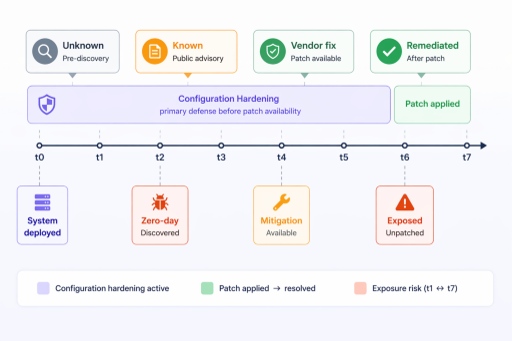
If the timeline has compressed, then the most important number in your risk management program is no longer just how many vulnerabilities you have. It’s how long each one stays open. Call it the exposure window: the time between when a weakness becomes exploitable and when you’ve actually closed it.
It’s worth being precise about why this reframing matters. A critical misconfiguration that exists for two hours and a critical misconfiguration that exists for two months represent wildly different amounts of real risk, even though a vulnerability count treats them identically.
Risk isn’t just severity – it’s severity multiplied by the length of time you’re exposed to it. In a world where exploitation is fast and cheap, duration is the variable you have the most control over, and the one that increasingly decides outcomes.
The problem is that the traditional way of managing the security of your storage and backup environment is structurally bad at keeping that window short.
An annual audit tells you your posture on one day of the year. A quarterly review leaves a quarter of blind time. Configurations drift between checks as people make changes; new advisories land constantly; something that was hardened in January has quietly slipped by March. Point-in-time assessment was designed for a world where the exposure window could afford to be wide. That world is gone.
Closing the gap
Winning this race doesn’t require matching attackers’ speed at inventing attacks – that’s not a contest defenders can win directly. It requires collapsing the exposure window on your side: knowing your storage and backup posture continuously rather than periodically, seeing weaknesses and configuration drift as they emerge rather than at the next scheduled review, and getting the highest-risk issues into remediation before the compressed timeline works against you.
This is the specific problem StorageGuard was built to address.
Rather than treating storage and backup security as something you check on a calendar, it continuously assesses configurations across multi-vendor environments – primary storage, backup platforms, and the recovery layer – against vendor best practices and established hardening baselines, surfaces drift and exposures as they appear, and prioritizes what to fix first based on real risk.
The point isn’t to replace the security judgment your team brings; it’s to make sure that judgment is applied to a current picture instead of a stale one, and that the exposure window stays measured in the timeframe you can defend rather than the one attackers are counting on.
The race between exposure and exploitation isn’t hypothetical, and it isn’t slowing down. AI has already changed how fast the attacker’s side of it moves.
The organizations that stay ahead won’t be the ones with the fewest weaknesses – every enterprise of any size will always have some. They’ll be the ones who find and close their weaknesses faster than those weaknesses can be turned against them.
In the world of storage and backup, where the stakes are your ability to recover at all, that’s a race worth taking seriously now, while there’s still room to get ahead of it.
Want to know where you actually stand?
Reading through five domains is one thing; knowing how your own estate scores against them is another. That’s exactly why we built the Enterprise Storage & Backup Security Self-Assessment.
It walks you through these same five domains and gives you back a weighted scorecard that surfaces your gaps and shows you which controls to fix first.
Take the Enterprise Storage & Backup Security Self-Assessment
Frequently Asked Questions (FAQs)
Why are ransomware attackers targeting storage and backup infrastructure?
Attackers target storage and backup systems because compromising them removes an organization’s ability to recover without paying a ransom. Modern ransomware campaigns often begin by deleting snapshots, corrupting or encrypting backup repositories, altering retention settings, or disabling immutability — neutralizing the recovery capability before encrypting production data. This makes the attack far more profitable, since a victim with intact, isolated backups can refuse to pay, while one whose backups were quietly compromised faces a business-critical crisis. Storage estates are also frequently under-hardened, with multiple vendor platforms, exposed management interfaces, and default configurations that make them attractive, high-value targets.
How is AI changing ransomware attack timelines?
AI is dramatically compressing the time between when a vulnerability becomes known and when it is actively exploited — shrinking that window from weeks or months toward days or even hours. Historically, exploiting a weakness in a specific storage platform required scarce, expensive expertise, which limited how many targets attackers pursued. AI now automates the tasks that used to gate an attack — reading advisories, understanding unfamiliar platforms, identifying exploitable configurations, and drafting exploit code — so attacks can be developed faster and by less-skilled actors. This also makes attackers less selective, since previously overlooked systems like regional backup appliances are now cheap enough to target.
What is an exposure window in cybersecurity?
An exposure window is the length of time between when a security weakness becomes exploitable and when it is actually remediated. It matters because real risk is not just the severity of a vulnerability but severity multiplied by how long the system remains exposed. A critical misconfiguration open for two hours poses far less risk than the same misconfiguration open for two months, even though a simple vulnerability count treats them the same. As AI makes exploitation faster and cheaper, reducing the exposure window has become one of the most important and controllable metrics in storage and backup security.
Why are periodic security assessments no longer enough for storage and backup systems?
Periodic assessments — such as annual audits or quarterly reviews — only capture an organization’s security posture at a single point in time, leaving long stretches of unmonitored risk in between. Storage and backup configurations drift as teams make routine operational changes, new security advisories emerge constantly, and a system hardened one month can silently fall out of compliance the next. Because AI has compressed exploitation timelines, these gaps between reviews are now long enough for attackers to find and exploit weaknesses. This is why organizations are moving from point-in-time assessment to continuous hardening and monitoring.
How can organizations reduce the exposure window for storage and backup security?
Organizations reduce the exposure window by shifting from periodic checks to continuous assessment of their storage and backup posture, detecting configuration drift and new exposures as they emerge rather than at the next scheduled review, and prioritizing remediation based on actual risk. The goal is not to match the speed at which attackers develop new exploits, but to find and fix weaknesses faster than they can be used. Solutions like StorageGuard support this by continuously assessing configurations across multi-vendor storage, backup, and recovery environments against vendor best practices and hardening baselines, surfacing drift and exposures, and helping teams remediate the highest-risk issues first.
Talk To An Expert
Ensure your storage & backup systems are hardened and compliant.