Storage in the AI Era: What Enterprise Leaders Are Learning About Performance, Protection & Resilience
About Core6™
StorageGuard - by Core6 - is the ONLY Security Posture Management solution for Storage & Backup systems, helping to ensure these systems are secure and compliant.
AI is rapidly reshaping enterprise storage.
What started as a conversation about GPUs and infrastructure performance has evolved into something much broader: data growth, cyber resilience, recovery readiness, governance, and entirely new architectural approaches.
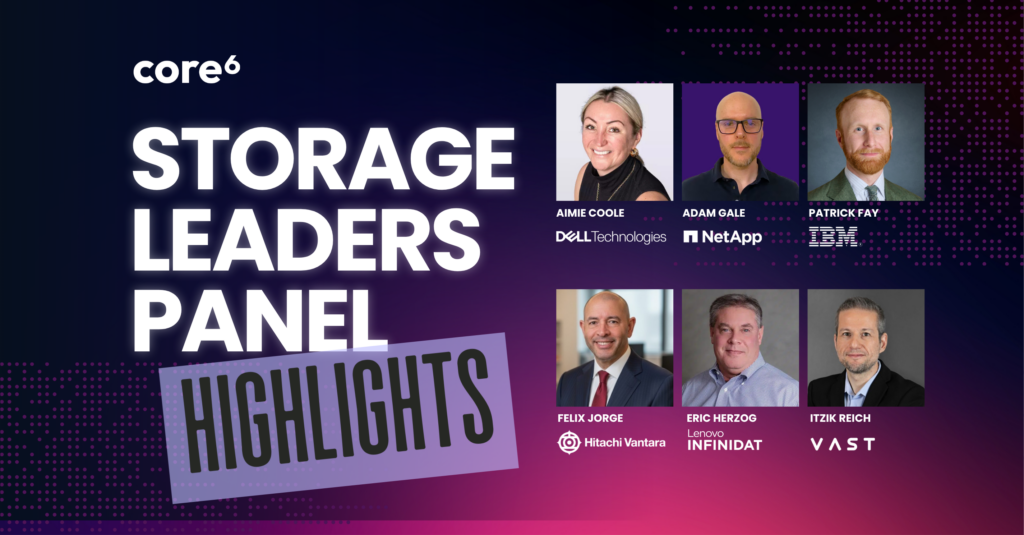
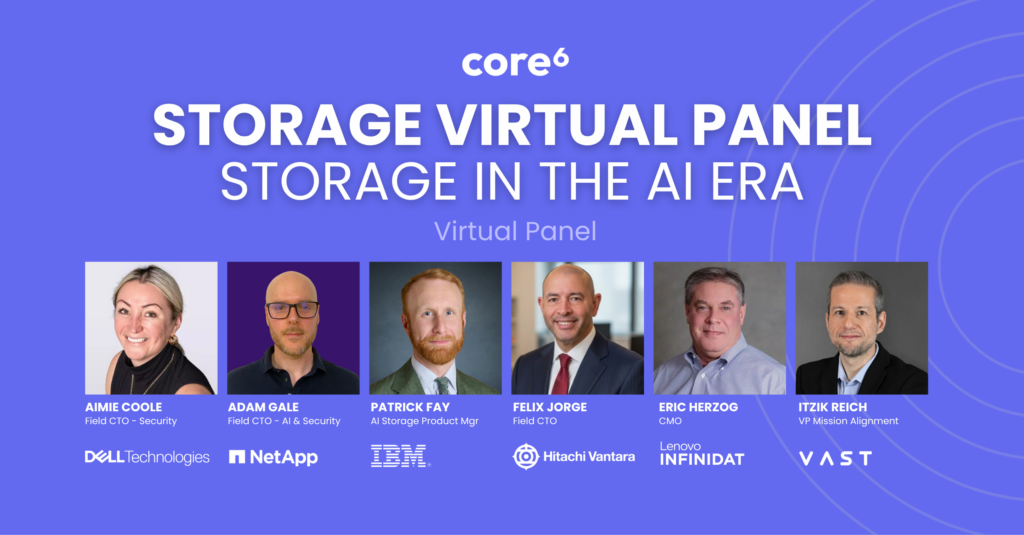
These themes were front and center during a recent Storage Leaders Virtual Panel, which brought together experts from Dell Technologies, NetApp, Hitachi Vantara, IBM, Infinidat (Lenovo), and VAST Data to discuss how AI is changing the way organizations think about storage.
While the panelists represented different vendors and viewpoints, there was remarkable agreement on one point: Storage is no longer just about storing data. It’s becoming the foundation on which enterprise AI initiatives succeed – or fail.
Storage Has Moved to the Center of the AI Conversation
One of the most striking observations of the discussion was how dramatically the storage conversation has changed over the past 18 months.
According to Itzik Reich, VP Mission Alignment at VAST Data, storage discussions used to be confined to infrastructure teams and procurement departments. Today, CTOs, Chief Data Officers, AI leaders, and even board members are involved because storage has become directly tied to AI outcomes.
The metric that increasingly matters isn’t IOPS or throughput. It’s GPU utilization.
Patrick Fay, AI Storage Product Manager at IBM reinforced this shift from another angle. AI is creating unprecedented pressure on infrastructure supply chains. The industry started by worrying about GPU shortages. Then memory became constrained. Now storage is experiencing similar pressures as demand drives up the cost of NAND and HDD capacity.
AI Doesn’t Create One Storage Problem. It Creates Four
According to Itzik, every phase of the AI lifecycle stresses storage differently.
- Training: Metadata often becomes the bottleneck before throughput.
- Checkpointing: Massive bursts of write activity can leave GPUs idle while waiting for storage.
- Inference: Latency matters more than average performance.
- RAG: Storage must simultaneously act as a data lake, database, and vector store.
Patrick highlighted an additional challenge: organizations are dramatically underestimating how much data AI will generate. Many enterprises are seeing datasets expand several times over through embeddings, metadata, and AI-generated outputs.
The Biggest Gap Isn’t Technology. It’s Architecture
Felix Jorge, Field CTO at Hitachi Vantara argued that the biggest challenge isn’t technology. It’s architectural intent.
Legacy environments were designed around predictable workloads and gradual growth. AI changes those assumptions completely.
Organizations can no longer rely solely on capacity forecasting and periodic refresh cycles. Instead, they must design architectures that adapt continuously.
Ransomware Has Moved Beyond Encryption
Adam Gale, Field CTO – AI & Security at NetApp observed that modern attacks are increasingly becoming three-stage operations: breach and encrypt, exfiltrate data, and corrupt recovery mechanisms.
Felix expanded on this trend, explaining that attackers are increasingly targeting backup infrastructure, replication paths, recovery environments, privileged accounts, and immutable storage copies.
The goal is no longer simply disruption. It’s the destruction of confidence in recovery.
Most Organizations Overestimate Their Recovery Readiness
Aimie Coole, Field CTO – Europe at Dell Technologies noted that many organizations assume recovery will work when needed. Unfortunately, that assumption is often wrong.
Common issues include missing incident response plans, untested recovery procedures, outdated runbooks, poor communication processes, end-of-life infrastructure, and insufficient telemetry.
As Aimie summarized: Most organizations test for backup success, not operational recovery success.
Eric Herzog, CMO at Infinidat (Lenovo) took this argument further, encouraging organizations to treat cyberattacks as disasters and practice recovery accordingly.
Storage Still Has a Visibility Problem
Aimie argued that while storage teams generally have good visibility into capacity, availability, and performance, many have limited visibility into identity risks, privileged account exposure, configuration drift, recovery readiness, and backup security posture.
Eric reinforced this point, arguing that storage teams are too often excluded from broader cybersecurity initiatives despite managing the vast majority of enterprise data.
AI Is Both the Threat – And the Defense
Adam brought an important note of optimism to the discussion.
His view: We are entering a golden age of cyber resilience.
For the first time, defenders have access to AI-powered tools capable of identifying anomalies, accelerating investigations, and strengthening security at scales that would previously have required thousands of analysts.
At the same time, AI introduces new risks, including AI-generated phishing, deepfake impersonation, voice cloning, and data poisoning.
The Future of Storage
The session concluded with a discussion about storage refresh cycles.
Patrick believes AI-focused storage infrastructure may evolve faster than traditional storage environments. Felix argued that organizations should focus less on refresh cycles and more on building architectures that can evolve incrementally over time.
Final Thoughts
Storage is no longer simply an infrastructure layer.
It’s becoming a performance platform for AI, a control point for cyber resilience, a governance and compliance layer, and a business continuity dependency.
The future of storage will be defined by an organization’s ability to balance performance, protection, and resilience simultaneously.
Watch the recording of the Storage Leaders Virtual Panel at https://www.core6.com/resources/storage-leaders-virtual-panel-storage-in-the-ai-era-performance-protection-resilience/
Frequently Asked Questions (FAQs)
What is AI-ready storage?
AI-ready storage is storage infrastructure designed to support AI and machine learning workloads, including model training, inference, checkpointing, and retrieval-augmented generation (RAG). It must deliver high performance, low latency, scalability, and cyber resilience.
Why is cyber resilience becoming a storage issue?
Storage and backup systems have become primary targets for ransomware attacks. If attackers compromise storage, backups, or recovery systems, organizations may be unable to restore critical business services after an attack.
What is storage security posture management?
Storage Security Posture Management (SSPM) is the practice of continuously assessing the security configuration of storage and backup systems to identify: exposure to vulnerabilities and security advisories, security misconfigurations, configuration drift, compliance violations, and missing security controls
What should infrastructure leaders prioritize when preparing storage for AI?
Infrastructure leaders should focus on: performance, data management, cyber resilience, recovery readiness, security posture management, governance and compliance, and scalability.
The most successful organizations treat performance, protection, and resilience as equally important requirements.
Talk To An Expert
Ensure your storage & backup systems are hardened and compliant.