
Close the Exposure Window: Faster Remediation for Storage & Backup
About Core6™
StorageGuard - by Core6 - is the ONLY Security Posture Management solution for Storage & Backup systems, helping to ensure these systems are secure and compliant.
Why AI has broken the ticket queue for storage and backup security — and what to do about it.
Finding a weakness has never been the hard part.
The hard part is the wait that follows — the days or weeks between the moment you know something is exposed and the moment it’s actually fixed.
For most security teams, that wait is invisible in the metrics. It hides inside a ticket, sitting in someone else’s queue, aging quietly while the risk it represents stays wide open.
That gap has a name worth using: the exposure window. It’s the time a known weakness remains exploitable. And in storage and backup infrastructure specifically, it’s become the number that matters most — because the thing attackers are after is the one thing a slow remediation process can’t protect in time.
Why security teams can no longer depend on ticket queues
The ticket queue has been the backbone of remediation for years, and for good reason. It creates accountability, a paper trail, and an orderly way to hand work from the people who find problems to the people who fix them. None of that is wrong. The problem is timing.
A ticket queue is built around a comfortable assumption: that the time a weakness sits waiting doesn’t materially change the risk. Fix it this sprint or next, and the outcome is roughly the same. For a long stretch of security’s history, that assumption mostly held. It doesn’t anymore.
The reason is that the other side got faster. AI has collapsed the time between a vulnerability becoming known and a working exploit existing for it – from months down toward days, and in some cases hours.
The expertise that used to gate an attack, the slow specialist work of understanding an unfamiliar system and building something to exploit it, is exactly the work these tools now accelerate. So the same ticket that would have been safe sitting in a queue for three weeks is now sitting there through the entire window in which it’s most likely to be exploited.
This is especially acute for storage and backup, for two reasons.
First, these systems are where the data and the recovery capability live, so they’re the highest-value target in a ransomware operation. Second, they’re often outside the reach of the tooling security teams rely on – mainstream vulnerability scanners largely don’t cover storage arrays and backup appliances, so exposures there are frequently found late, by hand, and then routed into the same slow queue as everything else.
Late discovery plus slow remediation is the worst possible combination for the most valuable systems you own.
The uncomfortable conclusion is that a process optimized for order and accountability is no longer optimized for the thing that now determines outcomes: speed.
The queue isn’t broken. It’s just aimed at the wrong target. When the exposure window is the metric that decides whether an incident is recoverable, a remediation model that treats time as a free variable is a liability.
The instinct that makes it worse
There’s a natural response to all of this, and it’s the wrong one: go faster by cutting corners. Push changes straight to production. Skip the review. Let whoever’s closest just fix it. When the pressure is on and the window is closing, the temptation is to trade safety for speed.
When it comes to storage and backup systems, that trade is particularly dangerous.
These aren’t endpoints you can reimage if a change goes wrong. A careless change to a retention policy, a zoning configuration, or a replication relationship can take an application offline or, worse, quietly undermine the very recovery capability you’re trying to protect.
The cure becomes indistinguishable from the disease. Speed that introduces new risk isn’t remediation – it’s just a different exposure with a shorter fuse.
So the real challenge isn’t simply “go faster.” It’s the harder thing: compress the time from exposure to fix while actually reducing risk at every step. Those two goals sound opposed. They aren’t, but reconciling them requires changing the shape of the process, not just its speed.
Accelerating remediation without increasing risk
The path from exposure to remediation has a fixed set of stages, and most of the delay lives in the seams between them rather than in the fixing itself. Compressing the path means attacking each stage deliberately.
It starts with identification. You can’t remediate what you can’t see, and if storage and backup exposures are discovered late, everything downstream starts late too.
Continuous assessment across the whole multi-vendor storage and backup environment – rather than periodic, manual checking – is what moves discovery from “eventually” to “as it happens.”
The clock on the exposure window starts when the weakness appears, not when someone finally notices it, so the earlier you see it, the more of that window you get back.
Next is prioritization, which is where a surprising amount of time is quietly lost.
A remediation process drowning in undifferentiated findings can’t move fast on any of them, because everything looks equally urgent and nothing is. The teams that remediate quickly aren’t the ones working through a flat list top to bottom – they’re the ones who can tell, immediately, which handful of exposures actually carry real risk given how their environment is configured, and route their limited time there first.
Prioritization isn’t overhead on the way to remediation. It’s the thing that makes fast remediation possible at all.
Then comes the fix itself – and this is where the speed-versus-safety tension is sharpest, and where it can actually be dissolved.
The way to remediate quickly without adding risk is to close the gap between knowing the fix and applying it, while keeping a human in control of the decision. That means surfacing the specific, correct remediation for that storage platform rather than making an engineer research it from scratch; showing exactly what a change will do and what it will touch before it runs; and executing through a validated, reversible path rather than a one-way door.
The engineer stops spending hours assembling the fix by hand and spends their judgment where it matters – on whether to apply it – which is both faster and safer than the manual alternative.
The final seam is validation. A fix that isn’t verified isn’t finished, and a remediation process that closes tickets on trust rather than proof leaves exposure windows open that everyone believes are shut.
Confirming that the change actually took effect – and that it didn’t break something else or drift back over time – is what turns “we remediated it” into “we can prove it’s remediated.” It also feeds back into the first stage: continuous validation is just continuous identification pointed at your own fixes.
Put those together and the shape of the improvement becomes clear. You’re not asking people to work faster or take bigger risks. You’re removing the delay that lives between the stages – the late discovery, the undifferentiated pile, the hours of manual research, the unverified close – so that the human judgment which should govern remediation is applied to a current, prioritized, well-understood picture instead of a stale one.
The window closes faster because the process wastes less time, not because anyone cut a corner.
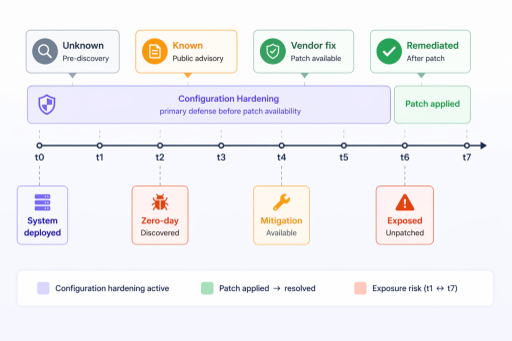
This is the problem StorageGuard is built to solve across enterprise storage and backup infrastructure.
It continuously and autonomously identifies exposures across multi-vendor storage and backup, systems (Dell, NetApp, Hitachi Vantara, HPE, Everpure, Rubrik, Cohesity, Commvault, Vast, etc.), prioritizes them by real risk so teams act on what matters first, and turns each finding into specific, validated remediation guidance – with the change and its impact visible before anything runs, and a human approving every step.
The goal isn’t to remove people from the loop. It’s to give them back the time that the loop was wasting, so the exposure window is measured in a timeframe that actually protects the recovery layer.
The shift here is one of mindset before tooling. As long as remediation is treated as a task that happens whenever the queue gets to it, the exposure window is set by your backlog rather than by your risk. Treat it instead as the number that determines cyber resilience – the time your most valuable systems stay exploitable – and the priority becomes obvious: close it fast, close it safely, and stop letting the most important fixes age quietly in a queue that was never designed for a world this quick.
Want to know where you actually stand?
Reading through five domains is one thing; knowing how your own estate scores against them is another. That’s exactly why we built the Enterprise Storage & Backup Security Self-Assessment.
It walks you through these same five domains and gives you back a weighted scorecard that surfaces your gaps and shows you which controls to fix first.
Take the Enterprise Storage & Backup Security Self-Assessment
Frequently Asked Questions (FAQs)
What is the exposure window in storage and backup security?
The exposure window is the length of time a known security weakness remains exploitable – from the moment it appears or is discovered to the moment it is actually remediated and verified. It matters because real risk is a function of both severity and duration: a critical misconfiguration open for a week is far more dangerous than the same issue open for an hour. In storage and backup infrastructure, where systems hold both the data and the recovery capability, a long exposure window directly determines whether a ransomware incident is recoverable. Reducing that window is now one of the most important measures of cyber resilience.
Why can’t security teams rely on ticket queues for remediation anymore?
Ticket queues assume that the time a weakness spends waiting doesn’t materially change the risk – that fixing it this sprint or next produces roughly the same outcome. AI has broken that assumption by collapsing the time between a vulnerability becoming public and a working exploit existing, from months toward days or hours. A ticket that once sat safely in a queue for weeks now ages through the entire window in which it is most likely to be exploited. This is especially acute for storage and backup, which are high-value ransomware targets and are often discovered late because mainstream vulnerability scanners don’t cover them. The queue still provides accountability, but it is no longer aligned with the speed that now determines outcomes.
How can you accelerate remediation without increasing risk?
The key is to compress the time between each stage of remediation rather than cutting corners on the fix itself. That means identifying exposures continuously so discovery starts early, prioritizing by real risk so effort goes to what matters first, surfacing the specific validated fix for each platform so engineers don’t research it from scratch, showing exactly what a change will do before it runs, and executing through a reversible, verified path with a human approving each step. This closes the gap between knowing a fix and applying it while keeping human judgment in control – which is both faster and safer than manual remediation. Speed comes from removing delay between stages, not from skipping safety.
Why is fast remediation especially critical for storage and backup systems?
Storage and backup systems are the highest-value target in a ransomware operation because they hold both the data and the ability to recover it. Attackers increasingly compromise these systems first – corrupting backups, disabling immutability, or altering retention – to remove a victim’s ability to recover without paying. At the same time, these systems are frequently outside the reach of mainstream security tooling, so exposures are found late and remediated slowly. Late discovery combined with slow remediation on the most valuable systems is the worst possible combination, which is why compressing the exposure window matters most precisely here.
How does StorageGuard help reduce remediation delays?
StorageGuard reduces the exposure window across storage and backup infrastructure by attacking each stage of the remediation path. It continuously identifies exposures across multi-vendor storage, backup, and recovery systems; prioritizes them by real risk so teams focus on what is most likely to be exploited; and converts each finding into specific, validated remediation guidance, with the change and its impact shown before it runs and a human approving each step. Rather than routing storage and backup exposures into a slow manual queue, StorageGuard compresses the path from exposure to verified fix – accelerating remediation while keeping human judgment and reversibility in control, so speed never comes at the cost of new risk.
Talk To An Expert
Ensure your storage & backup systems are hardened and compliant.